
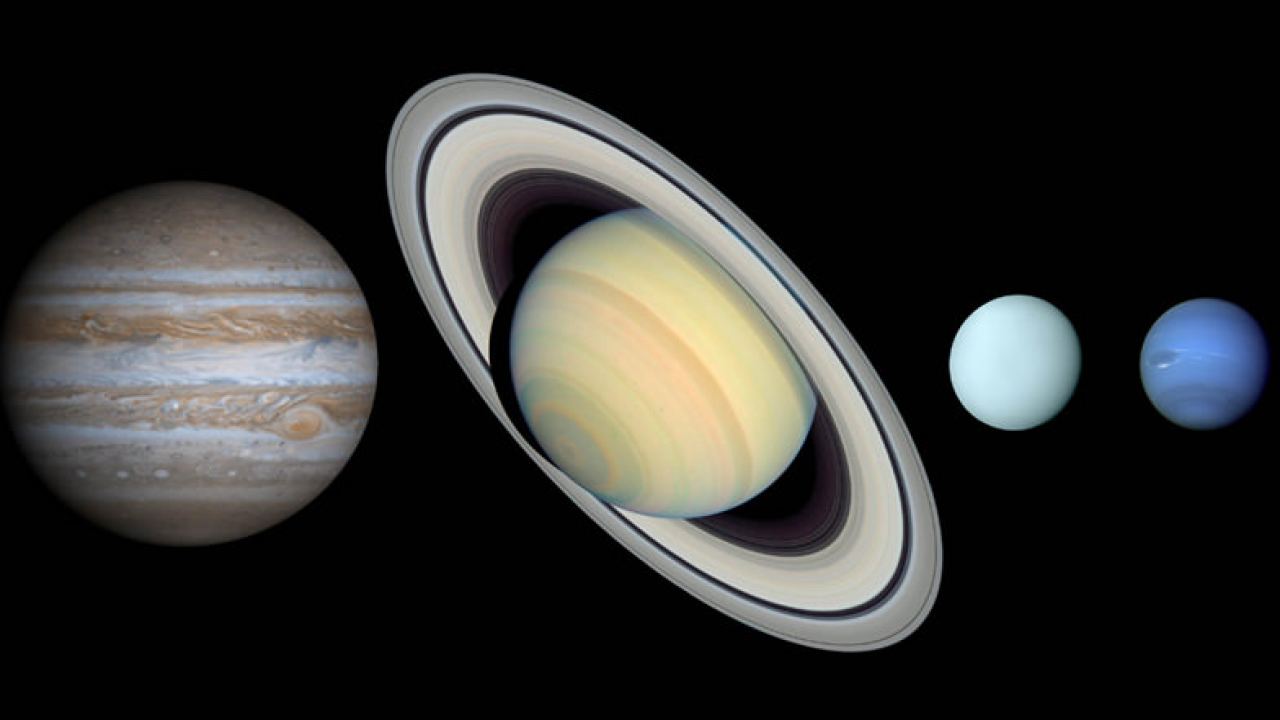
The external planets of our Planetary group, upon assessment, assist us with truly grasping the sheer size of our own framework, however the entire Universe. There are four external planets in our planetary group. They are as per the following: Jupiter, Saturn, Uranus, and Neptune.
Jupiter
As we branch out past Mars and the Space rock Belt, we track down the fifth and biggest planet in our nearby planet group, Jupiter. The biggest planet in our nearby planet group, Jupiter, is enormous to the point that north of 1,000 Earths could fit inside it. Jupiter comes as close as 365 million miles from the Earth at its nearest point in circle. That is more than the separation from Mercury to the Earth, Venus to the Earth, and Mars to the Earth joined! Its separation from the Sun is considerably more exceptional: 460 million miles at its nearest and 508 million miles at its farthest point in circle. It takes Jupiter 12 Earth a long time to circle the Sun and twists on its own hub each 9.8 hours. This implies that Jupiter is turning rapidly about its own hub, barely shy of multiple times as quick as the Earth turns. Jupiter is significantly colder than the Earth. Readings coming from the cloud tops show that temperatures are about – 101 degrees Fahrenheit. Jupiter is set apart by huge whirls of mists and its most notable element is the Incomparable Red Spot. The Incomparable Red Spot is a tremendous tempest that actions around 24,860 miles across. That is sufficiently large to contain barely short of three planet Earths! One more significant element of Jupiter is its immense number of satellites, or moons. The ongoing count is at 63.
- https://campus.extension.org/mod/forum/discuss.php?d=63935
- https://campus.extension.org/mod/forum/discuss.php?d=63950
- https://campus.extension.org/mod/forum/discuss.php?d=63943
- https://campus.extension.org/mod/forum/discuss.php?d=63938
- https://campus.extension.org/mod/forum/discuss.php?d=63941
- https://campus.extension.org/mod/forum/discuss.php?d=63914
- https://campus.extension.org/mod/forum/discuss.php?d=63915
Saturn
Saturn is the second biggest planet, situated around 746 million miles from our planet Earth. This is two times as distant as Jupiter is from the Earth! During its circle around the Sun, Saturn goes from 840 million miles to 938 million miles from the Sun. It takes Saturn just about 30 Earth a very long time to make it around the Sun. Like Jupiter, Saturn is turning about its pivot a lot quicker than the Earth. Saturn takes just 10.67 Earth hours to turn once about its pivot. Cloud top temperature readings uncover temperatures of about – 274 degrees Fahrenheit. That is two times as cold as the record temperatures on The planet! Saturn’s most conspicuous component is its rings, which are made for the most part of ice and rock particles. Saturn’s ring framework really comprises of numerous more modest rings rather than one huge ring. The particles range in size two or three centimeters to over a kilometer in size. Saturn, similar to Jupiter, likewise has countless moons, and that number right now holds at 60 moons.
Uranus
Uranus denotes where we begin examining distances in billions of miles, not great many miles. Uranus is 1.6 billion miles from Earth, which is somewhat less than two times as distant as Saturn is from the Earth. Yet again this figure alone can assist us with starting to see the huge extent of our planetary group. Uranus goes from 1.7 billion and 1.87 billion miles from the Sun in its circle. Uranus requires 84 Earth a long time to make one upheaval around the Sun. In the normal human lifetime, Uranus will make only one entry around the Sun. How long does a day on Uranus endure? It takes Uranus a little more than 17 hours to rotate once on its hub. Temperatures on Uranus are much colder: – 328 degrees Fahrenheit. Uranus flaunts 27 known moons and a weak ring framework.
Neptune
The last perceived planet in our nearby planet group is Neptune. Neptune is nearest to our planet Earth when it is 2.68 billion miles away. Neptune’s nearest distance from the Sun is 2.77 billion miles and 2.87 billion miles away its farthest distance. That is right multiple times as distant from the Sun as planet Earth! While it appears to be that the time Uranus takes to circle the Sun is incredibly lengthy, Neptune accepts two times as lengthy. It requires 165 Earth a very long time for Neptune to make a solitary excursion around the Sun. A day on Neptune likewise requires 17 hours. Temperatures at the cloud tops are only a without a doubt colder than the temperatures on Uranus: – 346 degrees Fahrenheit. Neptune has 13 known moons and a weak ring framework. The most unmistakable element of Neptune must be the lovely blue variety that the methane in the mists reflects back to the watcher. Neptune additionally has an extraordinary tempest like Jupiter and is known as the Incomparable Dull Spot.
End
As may be obvious, the farther we venture outward in our planetary group, we can start to see exactly the way that broad the universe is. Our nearby planet group circles only one star, of billions stars in our system, which is only one world out of billions of different universes. Finding out about our external planets is only the start of a large number of regions to find about the Universe.
 Scienology
Leave a comment