
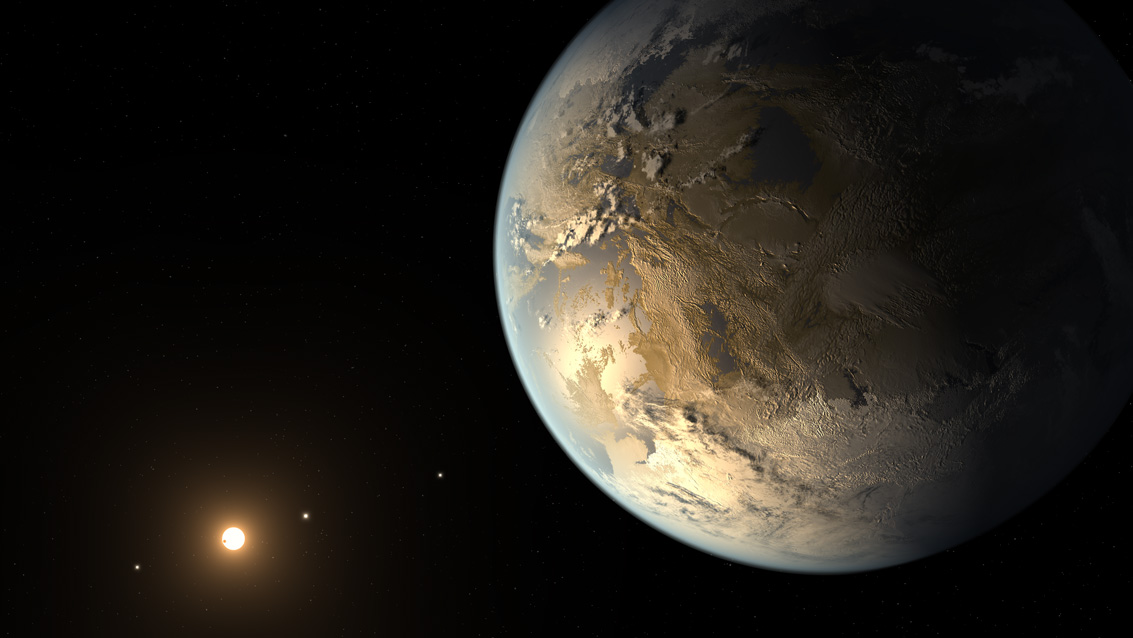
NASA’s disastrous be that as it may, by the by, very effective Kepler Space Telescope was sent off on Walk 7, 2009 from Cape Canaveral, Florida. Before its main goal reached an untimely conclusion in May 2013, Kepler had effectively observed in excess of 100,000 Sun-like stars, looking for blabbermouth changes in their splendor – because of the travel of an exoplanet before their glaring, splendid countenances. The quantity of exoplanet competitors saw as such a long ways by the profoundly useful Kepler is faltering – 3,800 up-and-comers still need to be contemplated. In April 2014, space experts reported that Kepler had prevailed with regards to packing the best exoplanet yet- – the main Earth-size planet circumnavigating a remote star inside its livable zone- – the scope of distance from a parent-star where water can exist in its life-accommodating fluid state. While “tenable” doesn’t convey a remarkable same significance as “occupied”, this really fabulous revelation surely demonstrates that planets the size of our own stay in the livable zones of stars other than our Sun. Where fluid water exists, life as far as we might be concerned might possibly develop and flourish.
Despite the fact that planets have recently been recognized circling their stars in that Goldilocks locale where it isn’t over the top hot or cool, however spot on for fluid water to exist, they are something like 40% bigger in size than our own planet- – and understanding their sythesis presents very much a test.
Nonetheless, the newfound exoplanet, named Kepler-186f, is sufficient like Earth to be its kissing cousin.
- https://campus.extension.org/mod/forum/discuss.php?d=64085
- https://campus.extension.org/mod/forum/discuss.php?d=64110
- https://campus.extension.org/mod/forum/discuss.php?d=64079
- https://campus.extension.org/mod/forum/discuss.php?d=64089
- https://campus.extension.org/mod/forum/discuss.php?d=64081
- https://campus.extension.org/mod/forum/discuss.php?d=64100
- https://campus.extension.org/mod/forum/discuss.php?d=64082
“The disclosure of Kepler-186f is a critical stage toward finding universes like our planet Earth. Future NASA missions, similar to the Traveling Exoplanet Review Satellite and the James Webb Space Telescope, will find the closest rough exoplanets and decide their structure and environmental circumstances, proceeding with humanity’s journey to find genuinely Earth-like universes,” made sense of Dr. Paul Hertz in an April 17, 2014 NASA Fly Drive Research facility Official statement. Dr. Hertz is NASA’s Astronomy chief at the office’s central command in Washington, D.C. The JPL is in Pasadena, California.
Despite the fact that the size of Kepler-186f not set in stone, its organization and mass are as yet unclear. In any case, prior research has shown that any planet the size of Kepler-186f would presumably be rough – like our own Earth.
“We are aware of only one planet where life exists- – Earth. At the point when we look for life outside our Planetary group, we center around tracking down planets with qualities that imitate that of Earth. Finding a livable zone planet practically identical to Earth in size is a significant forward-moving step,” noted Dr. Elisa Quintana in the April 17, 2014 JPL Official statement. Dr. Quintana is an examination researcher at the SETI Organization at NASA’s Ames Exploration Center in Moffett Field, California, and lead creator of the paper portraying this new disclosure distributed in the April 17, 2014 issue of the diary Science.
Dr. Quintana and her group spotted Kepler-186f moving around in the information got from the initial three years of Kepler’s useful mission. This far off world is somewhat colder and undeniably greater than our own, and despite the fact that it’s anything but an Earth-twin, it is positively a sufficiently nearby comparative with be welcomed with a kiss.
The group of researchers guess that World’s kissing cousin is made out of much a similar stuff as our planet- – iron, rock, fluid water, and ice. Be that as it may, the overall amounts could be incredibly unique on this far off world.
 Scienology
Leave a comment